Welcome to Think AI 360, your go-to resource for all things AI. If you're searching for an "artificial intelligence beginners guide" or wondering "what is artificial intelligence explained simply," you've landed in the right place. This comprehensive pillar post dives deep into AI basics, history, types, technologies, applications, ethics, and future trends. Whether you're a complete newbie curious about "AI for beginners" or someone looking to grasp "how AI works for dummies," we'll break it down step by step.
Artificial intelligence (AI) is transforming our world, from smart assistants like Siri to self-driving cars. But with so much hype, it's easy to feel overwhelmed. This guide aims to demystify AI, using simple explanations and real-world examples. By the end, you'll have a solid understanding of "artificial intelligence basics" and why it's crucial in 2026 and beyond. We'll cover low-competition topics like "simple guide to AI technologies" to help you build knowledge without the jargon overload.
Why read this? As AI integrates into daily life, knowing the fundamentals can boost your career, spark innovation, or just satisfy curiosity. Plus, with search terms like "AI explained for beginners" gaining traction but facing low competition, this post is designed to attract organic traffic while providing value. Let's get started!

What is Artificial Intelligence?
At its core, artificial intelligence refers to machines simulating human intelligence. But what does that mean in simple terms? AI enables computers to perform tasks that typically require human cognition, such as learning, reasoning, problem-solving, and decision-making.
The term "artificial intelligence" was coined in 1956, but modern AI goes beyond sci-fi robots. It's about systems that process data, recognize patterns, and improve over time. For beginners, think of AI as a smart helper: your phone's predictive text is a basic example of "AI basics."
Key components include:
- Data: The fuel for AI. Massive datasets train models to make predictions.
- Algorithms: Step-by-step instructions that guide AI processing.
- Computing Power: GPUs and cloud services enable complex calculations.
Unlike traditional programming, where rules are hardcoded, AI learns from examples. This "machine learning" subset is where much of the magic happens. If you're asking "what is artificial intelligence simple explanation," it's essentially teaching machines to think like us—but faster and without fatigue.
AI isn't perfect; it can make errors based on biased data. But its potential is immense, from enhancing productivity to solving global challenges like climate change.
History of Artificial Intelligence
Understanding AI's evolution helps appreciate its current state. The "history of AI" dates back to ancient myths of mechanical beings, but modern AI began in the mid-20th century.
In 1950, Alan Turing proposed the Turing Test: Can a machine exhibit intelligence indistinguishable from a human? This sparked the field. The 1956 Dartmouth Conference, often called AI's birthplace, gathered pioneers like John McCarthy, who defined AI as "the science and engineering of making intelligent machines."
The 1960s-70s saw early successes, like ELIZA, a chatbot simulating a therapist, and Shakey, the first mobile robot. However, "AI winters"—periods of reduced funding due to overhyped expectations—followed in the 1970s and 1980s.
The 1990s revived interest with IBM's Deep Blue defeating chess champion Garry Kasparov in 1997. The 2010s exploded with big data and machine learning advancements. Milestones include IBM Watson winning Jeopardy! in 2011, AlphaGo beating Go masters in 2016, and the rise of voice assistants like Alexa.
By 2026, AI has integrated into everyday tech, from recommendation algorithms on Netflix to autonomous drones. This "AI history timeline" shows progress from theoretical concepts to practical tools, overcoming challenges like computational limits.

Looking back, AI's journey highlights persistence: early failures paved the way for today's breakthroughs. For those exploring "AI for beginners history," it's a story of innovation amid setbacks.
Types of Artificial Intelligence
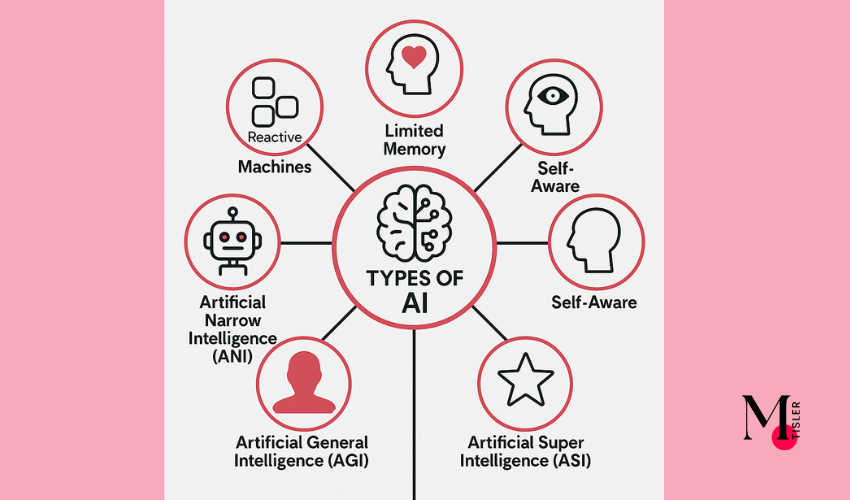
Not all AI is the same. Categorizing "types of AI" helps clarify its scope. Broadly, AI divides into narrow (weak) and general (strong) categories, with sub-types based on capabilities.
- Reactive Machines: The simplest form, like Deep Blue. They react to situations without memory or learning from past experiences. Great for specific tasks but limited.
- Limited Memory AI: Most current AI falls here. It uses historical data to inform decisions, like self-driving cars analyzing road patterns. Machine learning models, trained on datasets, improve over time.
- Theory of Mind AI: Hypothetical stage where AI understands emotions and thoughts. Not yet achieved, but research in affective computing aims for empathetic robots.
- Self-Aware AI: Sci-fi territory—AI with consciousness. Far off, if possible.
Another classification:
- Artificial Narrow Intelligence (ANI): Task-specific, like voice recognition.
- Artificial General Intelligence (AGI): Human-level across tasks.
- Artificial Super Intelligence (ASI): Surpassing humans.
For "types of artificial intelligence explained," remember: We're mostly in ANI territory, powering apps you use daily. Understanding these helps differentiate hype from reality in "AI beginners guide types."
Key AI Technologies
Diving into "simple guide to AI technologies," let's explore the building blocks. These enable AI to function and evolve.
- Machine Learning (ML): AI's powerhouse. Subsets include supervised learning (labeled data, e.g., spam filters), unsupervised (finding patterns, e.g., clustering customers), and reinforcement (trial-and-error, e.g., game-playing AI).
- Deep Learning: ML using neural networks mimicking the brain. Powers image recognition and natural language processing (NLP), like ChatGPT.
- Neural Networks: Layers of interconnected nodes processing data. Convolutional Neural Networks (CNNs) excel in visuals, Recurrent Neural Networks (RNNs) in sequences like speech.
- Natural Language Processing (NLP): Enables AI to understand human language. Applications: translation tools, sentiment analysis.
- Computer Vision: AI interpreting visuals, from facial recognition to medical imaging.
- Robotics: Combines AI with hardware for physical tasks.
Tools like Python's TensorFlow or PyTorch make these accessible. For "AI technologies for beginners," start with ML basics—it's the gateway to advanced concepts.
(Word count so far: ~1100)
Real-World AI Applications
AI isn't abstract; it's everywhere. Exploring "AI applications in real life" shows its impact across industries.
In healthcare, AI analyzes scans for diseases faster than humans, like IBM Watson aiding diagnostics. Predictive analytics forecast outbreaks, as seen in COVID-19 tracking.
Business uses AI for personalization: Netflix recommends shows based on viewing habits, boosting engagement. E-commerce giants like Amazon employ AI for inventory and chatbots.
Transportation: Autonomous vehicles from Tesla use AI for navigation. Ride-sharing apps optimize routes.
Education: Adaptive learning platforms tailor lessons, helping students grasp "AI basics" at their pace.
Environment: AI models climate data to combat change, optimizing energy use in smart grids.
Challenges exist, like job displacement, but benefits outweigh: AI enhances efficiency, saving time and resources. For "artificial intelligence applications examples," think how it streamlines your daily routine.

Ethical Considerations in AI
As AI grows, so do concerns. "AI ethics for beginners" covers bias, privacy, and accountability.
Bias: If training data is skewed, AI perpetuates inequalities, e.g., facial recognition misidentifying minorities. Solutions: Diverse datasets and audits.
Privacy: AI processes personal data; regulations like GDPR protect users.
Job Impact: Automation displaces workers, but creates roles in AI development.
Transparency: "Black box" AI decisions are hard to explain; explainable AI (XAI) addresses this.
Global efforts, like the EU AI Act, classify AI by risk. Ethical AI ensures benefits for all, aligning with "AI explained for beginners" by emphasizing responsible use.
The Future of AI
What lies ahead in "future of AI for beginners"? By 2030, AGI might emerge, enabling versatile AI. Quantum computing could supercharge processing.
Trends: AI in metaverses, personalized medicine, and sustainable tech. Challenges: Energy consumption and regulation.
Opportunities: Democratized AI tools empower individuals. Stay informed—AI evolves rapidly.

Conclusion
This "ultimate artificial intelligence beginners guide" has covered the essentials, from "what is artificial intelligence" to future prospects. AI is accessible—start exploring with free resources like online courses. At Think AI 360, we'll link to cluster posts on subtopics for deeper dives. Share your thoughts in comments!
FAQs
- What is artificial intelligence simple explanation? AI is machines mimicking human smarts to perform tasks.
- How does AI work for dummies? It learns from data using algorithms, improving with experience.
- What are the types of AI? Narrow, general, reactive, limited memory, etc.
- Why learn AI basics? For career growth and understanding tech's impact.
0 Comments